
business for good is good for business
Also brand building.
TOTD (thought of the day):
Did you know that doing business for good is good for business? 👩🏼💼
There was a study done by Kantar, following brands over 12 years.
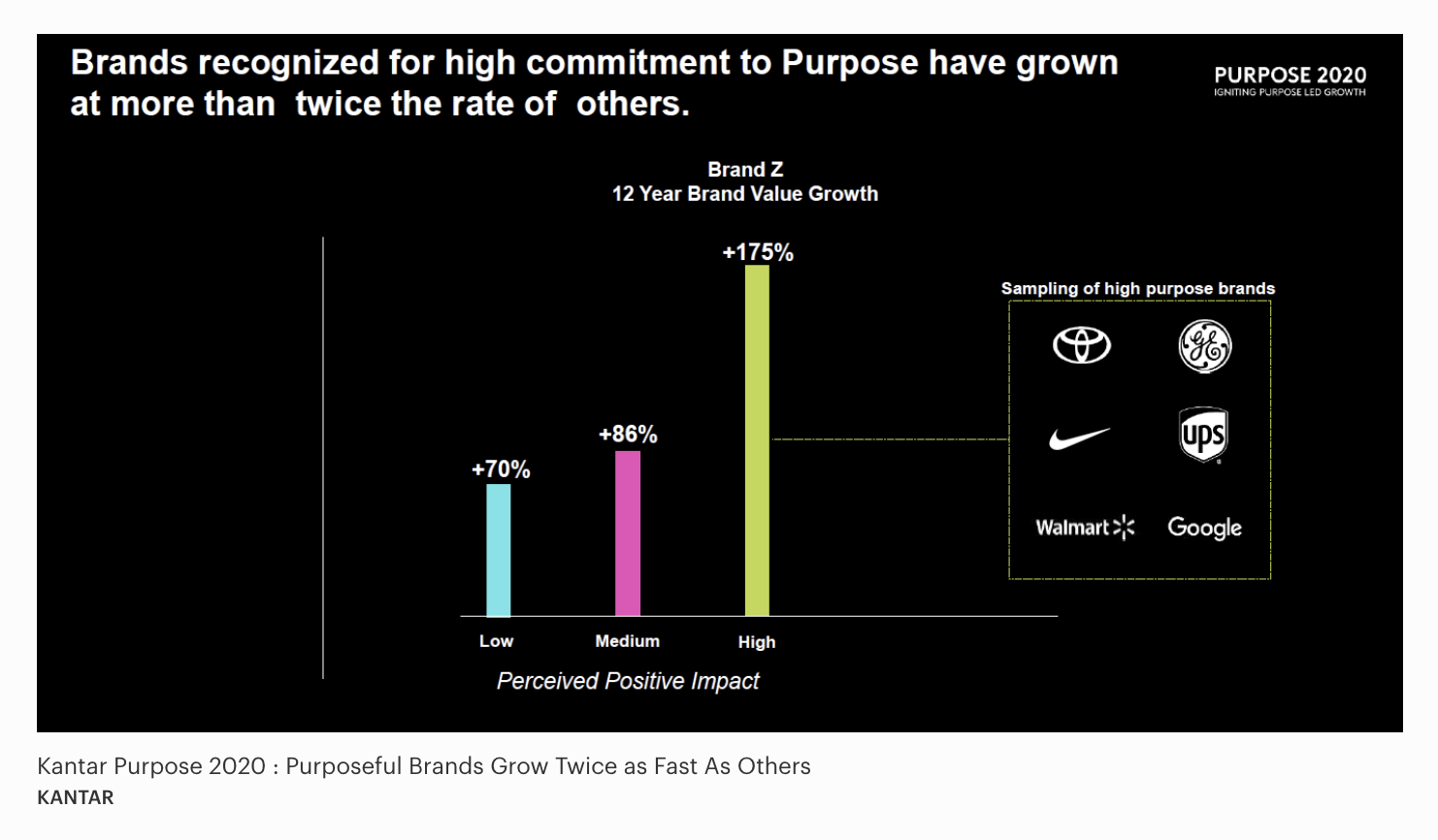
Source: Forbes article
It showed that brands that lead with purpose (and are outward about it) grew in brand value by 175% VS competitors who don't seem as purpose-driven.
If your brand value is higher it means higher trust, acquisition, loyalty, organic promotion, distribution, margins, and sales.
People often think user acquisition is a higher priority than brand building, and somehow don't realise how much brand building boosts growth (and survival).
It's harder to lose customers when they love your brand and what you stand for.
And it's easier for them to tell people about you when they love what you stand for. Sometimes it's easier to remember what good they are doing in the world than their name, have you ever noticed talking about someone doing something you found respectable but you forgot what they are called?
What's the purpose driving you and your business?
Mine is to help co-shape our collective future by co-building brands in tech that are making a positive impact on individuals, communities, and our world.
Tech is shaping our world and what our next chapter looks like, and I would like to say I made a dent in it by offering another perspective, and representation, in tech we are building today, for a better tomorrow for us all.
And using my business for good – building brands that stand for something, with purpose-driven people (usually tech founders).
ai adoption is actually shocking
🦞 OpenClaw is real and 7 billion people in the world have no clue what that is 👀
I read a stat the other day that, as much as we are living in an AI bubble
especially on LinkedIn, more than 80% of the world's population still hasn't used AI.
According to Microsoft’s Global AI Adoption 2025 research:
Only 16.3% of the world’s population uses generative AI
World population ≈ 8.1 billion 🌎
In a study by the European Commission, 32.7% of people aged 16–74 used generative AI in 2025.
In the Netherlands,
about 44% of people aged 17-74 have used AI in the past 3 months.
So every second person in NL has yet to experience the prompt box and communication with AI. I wonder what the percentage is in Amsterdam?
I've been meaning to post about the super insightful AI events I've been to over the last couple of weeks and already feel like what I saw – like at the OpenClaw demo last week at AI House in Amsterdam – feels like old news.
Then I saw this stat and I realised it's definitely not (old news).
Ironically I used AI to help me find the stat while I was drafting this post, and it led me to this page on the European Union website Eurostat.
And this report by McKinsey on AI adoption in companies.
I find it fascinating, hope you do too. I guess you wouldn’t have made it this far in the blog if you didn’t find this interesting.
I think it's an opportunity, and a blessing, that perhaps we still have time to positively influence the world, by shaping AI in a more ethically-minded way.
It's hard to be optimistic about whether that's a possibility based on what we've been seeing in the “AI race” on data security, the lack of diverse data we're training AI with, and most importantly the ones who are currently leading in the race.
Not as many diverse minds and ideas as we need to have at that level.
I’ve always been passionately interested in how tech shapes us as a society, and as individuals, and now, as humans. It’s one of the reasons why I love working in tech. I want to help co-create a more ethically future using tech, and it’s why I choose to partner with tech founders who are likeminded, and helping build their brand (and tech) to positively impact our world.
I believe it's my purpose, my ikigai.
Follow for more, or DM for collabs. Feel free to message me on Linkedin.
P.S. I'm currently onboarding new clients. And have 1 spot left.
If you happen to know a tech founder who is building something cool and could use a brand partner to build, or revamp, their brand for business growth, I’d love to chat. Send them my way!
What is a CCO+CBO?
Let’s take a look at what each is separately first:
Chief Creative Officer (CCO)
This is about expression.
The CCO role is where the brand becomes visible, tangible, and felt.
It’s the way the brand looks, sounds, moves, and shows up in the world — across visuals, language, content, campaigns, and customer experience.
As a CCO, I focus on:
Visual identity & design systems
Tone of voice & messaging
Content, campaigns, and storytelling
Creative direction across teams and channels
I lead creative output and decision-making, set the bar for quality, and make sure what’s being produced actually does the job — not just “looks nice”.
The questions I’m answering here are:
How do we tell this story?
What should this look and sound like?
Does this feel unmistakably us?
Chief Brand Officer (CBO)
This is about essence.
The CBO role goes deeper. It’s less about what people see today, and more about what the brand stands for over time.
This is where purpose, positioning, values, perception, and long-term brand equity live — internally and externally.
As a CBO, I focus on:
Brand purpose, vision, and positioning
Strategic direction and brand architecture
Consistency across product, marketing, culture, and hiring
Building brand trust, meaning, and long-term value
This work ensures the brand isn’t just coherent on the surface, but aligned at its core — so teams can actually use it to make decisions.
The questions I’m answering here are:
Why does this brand exist?
What does it stand for — really?
How does every part of the company live the brand?
The real difference (and why it matters)
Here’s the simplest way to think about it:
Scope:
CCO = creative execution and expression
CBO = holistic brand stewardship (inside and out)
Timeline:
CCO = campaigns, launches, moments
CBO = long-term brand health and future relevance
Relationship:
The CBO defines the brand foundations — the why and the what
The CCO brings it to life — the how it shows up
When these roles are disconnected, brands drift.
When they’re integrated, brands feel sharp, consistent, and confident.
Why I do both:
In practice, especially with founders and fast-moving teams, you don’t need more handovers — you need clearer thinking and better decisions.
I sit at the intersection of strategy and execution.
I define the brand and help you express it.
I make sure what you say, what you show, and what you build are all pointing in the same direction.
If you want to put it simply:
The CBO is the brand’s strategist and philosopher.
The CCO is the brand’s storyteller and visual architect.
I just happen to do both — so your brand doesn’t have to choose between meaning and momentum.
Let’s chat about your brand. Book a call here.